ARTICLES
Getting Your First Tattoo: What Nobody Tells First-Timers
A no-fluff first tattoo guide: pick an idea that holds, vet the right artist, survive consultation and deposits, and know what shop day actually looks like.
TL;DR: A good first tattoo guide isn't about picking the perfect design. It's about picking an idea that holds at size, finding an artist whose healed work backs up their feed, and showing up fed, sober, and ready to sit. Deposits are normal. The stencil stage matters more than you think. Aftercare is boring and non-negotiable. Manage your expectations on detail and you'll walk out happy.
You're in the chair. Stencil's on, you've checked it in the mirror three times, and the artist asks "we good?" Your stomach drops a little. That's the moment nobody warns you about: not the needle, the commitment. This first tattoo guide is for that exact second, and every decision that leads up to it.
Here's the thing most first-timers get wrong: they obsess over the design and ignore everything around it. The artist. The size. The placement. What the shop day actually feels like. A mediocre idea on solid skin with a great tattooer ages better than a "perfect" idea crammed too small by someone who shouldn't be holding a machine.
Getting tattooed is simple once you know the moves. But the gap between "I want a tattoo" and "I have a tattoo I still love in ten years" is full of small calls that nobody explains until you've already messed one up. Let's close that gap before you book.
What Makes a First Tattoo Idea Actually Hold?
A first tattoo idea holds when it survives shrinking. Bold shapes, clean negative space, room to breathe. If the concept only works packed with tiny detail, it's not built for skin: it's built for a screen. Pick something that reads from across the room, not something you have to squint at.
The trap is Pinterest. You save fifty fine-line micro-pieces with text thinner than a hair and think that's the standard. It's not. A lot of that work is fresh-photo magic that turns to mush within a few years. Tiggy Tattoos puts it plainly: fine detail needs space, and the same design slightly bigger holds its detail far longer as your skin ages.
So before you fall in love with a concept, ask one question: does this still work if it's the size of your palm, not your thumbnail? If the answer's no, simplify it or scale it up. Bold always holds. That's not an opinion, it's how ink behaves once the swelling goes down and the years pile on.
And don't rush. Live with the idea for a few weeks. The piece you're desperate to get on a Tuesday night isn't always the one you want forever. If you want a deeper read on what survives the long haul, how tattoos age breaks down which styles hold and which ones blur out.
How Do You Pick the Right Artist and Style?
Artists aren't interchangeable. A black-and-grey realism specialist is the wrong call for a bright trad rose, and a fine-line artist isn't your guy for a packed blackwork panel. Match the artist to the style first, then judge the artist. Their feed should be full of the thing you actually want, not "good in general."
Look at healed work, not fresh shots. Fresh tattoos all look crisp; the bandage just came off and the lines are swollen tight. The real test is what the piece looks like a year or two in. Any artist worth booking has healed photos. If their grid is wall-to-wall fresh bangers with zero healed examples, that's a flag, not a flex.
This is also where Instagram lies to you. The algorithm rewards saturated fresh-out-the-chair shots, which means a lot of talented tattooers get buried while flashy accounts float up. We dug into why Instagram is failing tattoo artists, worth reading before you let a follower count make your decision.
Watch how they communicate, too. Do they actually engage with your idea or just quote a price and ghost? A tattooer who asks questions about placement and flow is thinking about your skin. One who'll slap anything anywhere for the deposit is not. And steer clear of the scratcher working out of a kitchen: cheap permanent work is the most expensive thing you'll ever buy twice. If you're weighing platforms to find someone, Tatulogue vs Booksy vs StyleSeat compares where serious artists actually live.
What Happens at a Tattoo Consultation?
A consultation is a free sit-down where you and the artist lock in the idea: design, size, placement, color, budget, and a date. You bring references and a clear concept; they tell you what'll actually work on your body and what won't. It's a conversation, not a sales pitch. Come prepared and it goes fast.
Don't show up with a vague "I want something cool." Bring 2–3 reference images that show the vibe and style, not a design you expect copied line-for-line: most custom artists won't replicate another tattooer's piece, and you don't want them to. Let them draw it their way. That's what custom means.
This is also the moment to be honest about budget and ask the dumb questions now. How long will it take? One session or multiple? Where's the pain manageable for a first-timer? Three Kings Tattoo's etiquette guide is a good window into how a real shop runs its booking and what they expect from you. Good artists respect a client who asks instead of one who pretends to know everything.
How Do Tattoo Deposits Work?
A deposit is a non-refundable payment, usually a flat $25–$100 for small work or 10–50% on bigger custom pieces, that locks your slot and pays for the artist's drawing time. It comes off your final total. Pay a $100 deposit on a $300 piece, you owe $200 on the day. It's standard. Don't take it personally.
The deposit protects the artist from no-shows and from people who waste hours of design time then vanish. AuthorityTattoo's breakdown covers the norms: it's nonrefundable by default, but most shops honor it if you reschedule once with enough notice: often 48 hours. Cancel last-minute or repeatedly, and you'll lose it. Fair trade.
Read the shop's policy before you hand over money. A legit studio will tell you exactly how their deposit works in writing. If someone's cagey about it or wants the full price up front in cash with no paper trail, slow down. That's not how real shops operate. Tattoodo's first-timer walkthrough lays out the whole booking flow if you want the full picture before you commit.
What Does Tattoo Shop Day Actually Look Like?
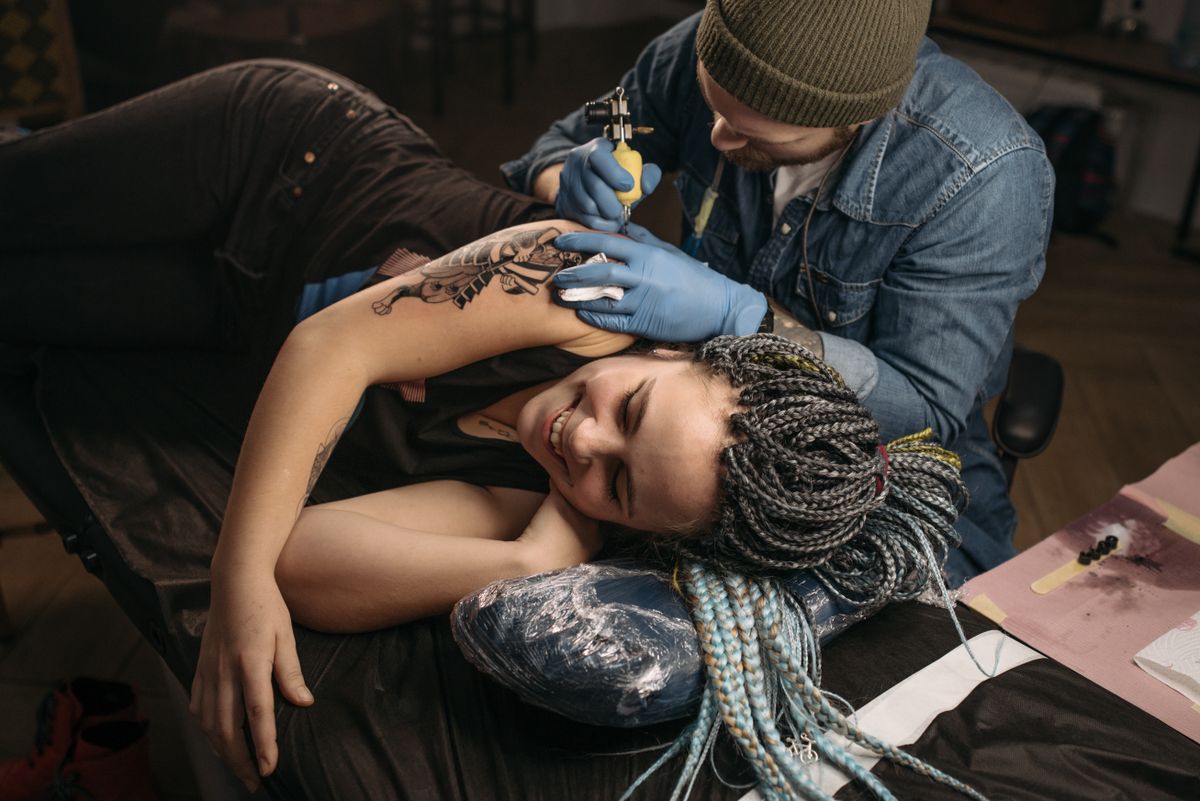
You show up, fill out a consent form, and get shown to the station. The artist preps: fresh needles out of sealed packaging, ink poured, the area shaved and cleaned. Then the stencil goes on. You check placement in the mirror, approve it, and they start. Outline first, then shading or color. Breaks happen on longer sessions.
The stencil stage is the most important thirty seconds of the whole day. Take your time here. Move around, twist, check it standing straight and relaxed, not just frozen in a mirror pose. If a stencil only looks right when you're holding yourself stiff, it won't sit right on a moving body. Speak up now; once the needle's in, it's permanent.
Then the machine starts and your brain recalibrates fast. The first few lines are the worst because of anticipation, not pain. After ten minutes most people settle in. It's an irritating scratch-burn, not the torture you built up in your head. Bring headphones, keep your phone charged, and don't watch the whole time if it makes you tense.
Should You Eat Before a Tattoo?
Yes, eat a real meal one to two hours before. Protein, complex carbs, some fat. Getting tattooed stresses your body and can drop your blood sugar, which is how people end up dizzy, nauseous, or passed out in the chair. Low blood sugar also cranks up how much the pain registers. Show up fueled.
Skip the sugary energy-drink-and-pastry move. That spikes you and crashes you right in the middle of the session. Mantra Tattoo's prep guide and most shops say the same thing: steady fuel, not a sugar bomb. Bring a snack and water for anything over an hour.
Two more rules that aren't optional. Don't drink the night before or day of: alcohol thins your blood, you'll bleed more, ink takes worse, and most artists will turn you away if you smell like a bar. And sleep. Tired skin sits worse and your tolerance tanks when you're running on empty.
Sitting Still: The Part Nobody Practices
Sitting still is a skill, and it's harder than it sounds. The needle isn't the challenge: staying relaxed for an hour-plus while your body wants to flinch is. Tense muscles make the artist's job harder and can affect line quality. Breathe slow, keep the area loose, and tell your artist when you need a break instead of white-knuckling it.
Flinching is normal early on. What matters is communicating. A good tattooer would rather pause for two minutes than fight a tightening shoulder. Don't be a hero: say "I need a sec," stretch, breathe, get back in it.
Watch the chatter, though. There's a line between staying relaxed and turning your session into a therapy hour the artist didn't sign up for. Read the room. Some artists love conversation, some want to lock in. Let them set the pace.
The Aftercare Reality Nobody Mentions
Aftercare is boring, repetitive, and the part that actually determines how your tattoo heals. Keep it wrapped per your artist's instructions, wash gently with clean hands and fragrance-free soap two to three times a day, pat dry, and apply a thin layer of balm: a sheen, not a glob. No soaking, no sun, no picking. For weeks.
When the wrap comes off, the tattoo looks wet, shiny, maybe slimy. That's plasma: blood, lymph, and excess ink weeping out. Totally normal. Mad Rabbit's first-48-hours timeline walks through exactly what you'll see and when. The goal of that first wash is clearing the weep so it doesn't dry into thick scabs, which are the enemy of a clean heal.
Then comes the itch. Around days four to seven it'll flake and peel like a sunburn and itch like hell. Do not scratch and do not pick the scabs: that's how you pull ink out and end up with patchy spots that need touching up. Slap it if you must, leave it otherwise. Our full tattoo aftercare guide and the tattoo healing stages breakdown cover the whole timeline day by day so you're not guessing at 2am wondering if that flaking is normal. It is.
Managing Expectations on Size and Detail
Your first tattoo will probably need to be bigger than you want it. First-timers lowball size to limit pain or cost, then cram in detail that the size can't hold. The dermis isn't paper: it spreads ink over time, and tiny gaps fill in. Give the design room or cut the detail. You can't have maximum detail and minimum size.
Trust your artist when they say "this needs to be bigger." They're not upselling: they've watched tight little pieces blur into smudges for years. A name in script the width of a pencil line will fade and bleed. The same name a touch bolder and bigger holds for decades.
And ditch the idea that your first has to be a hidden, tiny, "starter" tattoo. Plenty of people get a solid forearm piece first and never regret going bigger. If you're drawn to delicate work, go in eyes open: our fine line tattoos guide covers what that style realistically holds and what it doesn't.
Three things to walk away with. One: the idea matters less than the artist and the execution; vet healed work, not fresh feeds. Two: show up fed, sober, rested, and ready to sit still; the day goes smooth when your body cooperates. Three: aftercare is unglamorous and you do it anyway, because a clean heal is half the tattoo.
Your first won't be your last: almost nobody stops at one. The people walking around with collections they love didn't get lucky; they made smart calls at the booking stage and let good artists do good work. If you want to keep getting smarter before your next piece, the Tatulogue newsletter at tatulogue.com is where we break down styles, artists, and real healed work with zero content-farm filler.