ARTICLES
American Traditional Tattoos: Why Bold Still Holds
American traditional tattoos age better than almost anything: bold outlines, limited palette, solid fills. Here's the history, the motifs, and how to find a trad artist.
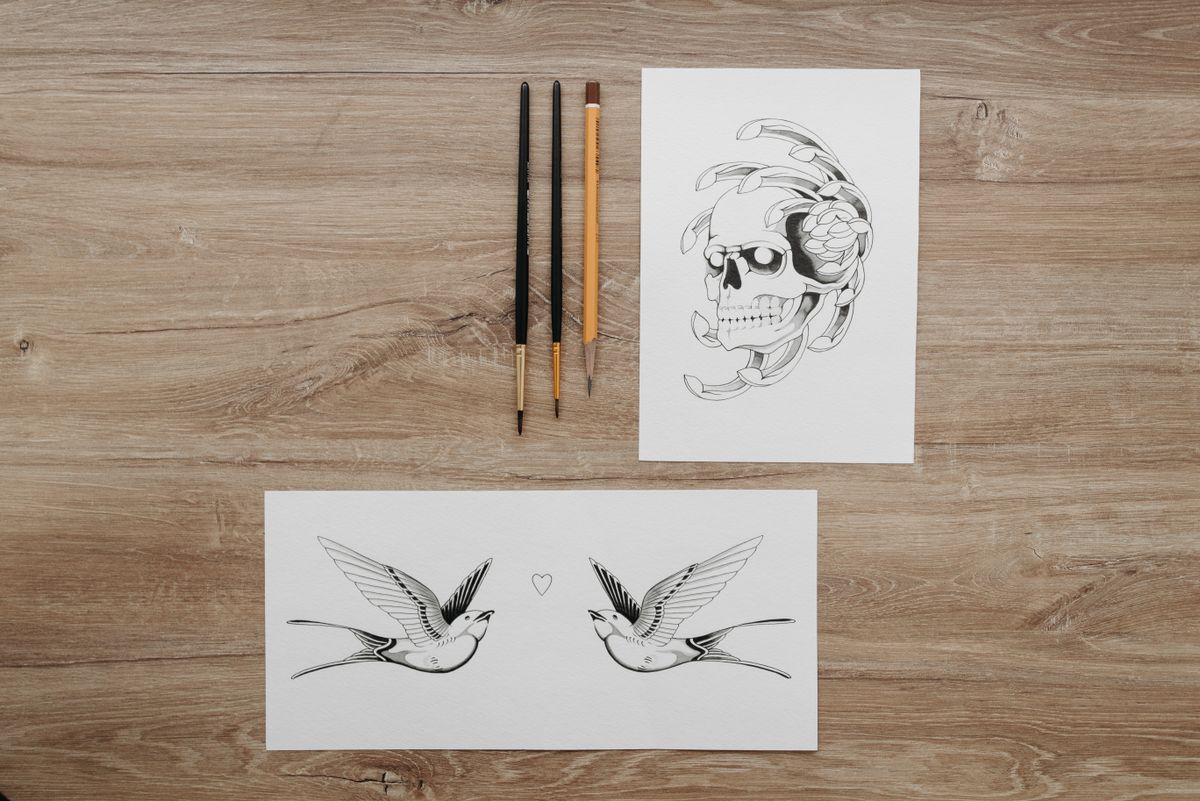
TL;DR: American traditional tattoos are built around bold black outlines, a limited palette, and solid flat fills: the exact recipe that ages cleaner than almost any other style. Born from Sailor Jerry and flash culture, the classics still hold: eagle, panther, rose, dagger, swallow. Neo trad expands the palette and detail. If you want a piece that reads sharp at sixty, trad is the safest bet on skin.
Walk into any old shop and look at the walls. Flash sheets, four to a frame, edges curling: eagles, daggers through hearts, a panther crawling down a sheet of bristol. That wall is the whole pitch for American traditional tattoos in one glance. Bold lines you can read across the room. A handful of colors. Nothing precious, nothing fussy.
There's a reason that style is still the spine of Western tattooing a hundred years in. Trad was never trying to look real. It was built to look like a tattoo, and to keep looking like one after decades of sun, stretch, and skin turnover. Bold always holds. That's not a slogan somebody printed on a tote bag. It's the design logic baked into every line weight and every flat fill.
This is the breakdown: where the style came from, what actually defines it, the motifs that never died, why it ages like nothing else, how it splits off into neo trad, and how to find someone who can put a clean one in you.
What Are American Traditional Tattoos?
American traditional tattoos, old school, are defined by thick black outlines, a tight color palette of red, yellow, green, and blue, and solid flat fills with no blending or gradients. The look is graphic and iconic by design, built to read instantly and stay readable for life. Sailor Jerry is the name most tied to the style.
Per Wikipedia's entry on American traditional, the work uses "recognizable shapes and objects" applied so they "remain clear on the skin over a person's lifetime." That last part is the whole game. Every trait of the style traces back to one question: will this still look like itself in thirty years?
Trad doesn't chase realism. It chases clarity. A trad rose isn't a botanical study: it's a symbol of a rose, packed solid, wrapped in a line you couldn't miss from across a parking lot.
The History: Sailor Jerry and Flash Culture
You can't talk trad without talking Norman Collins: Sailor Jerry. Born in 1911, he learned to tattoo by hand as a teenager, picked up the machine in the 1920s, and after a stint in the Navy settled in Honolulu, where he tattooed servicemen passing through on the way to and from the Pacific.
What Jerry did wasn't invent the imagery: sailors had been getting swallows and anchors for generations. He sharpened it. According to the official Sailor Jerry biography, he corresponded directly with Japanese tattoo masters, borrowed their sense of composition and body flow, and fused it with American iconography. He also pushed the craft forward technically: developing safer, more vibrant pigments and pioneering needle sterilization at a time the industry barely thought about it.
And he drew flash. Sheets and sheets of it: pin-ups, daggers, eagles, ships, designs a customer could point at and walk out wearing an hour later. That flash culture is the backbone of trad. It's also why the style is so consistent: everyone was working from a shared visual language, refining the same hundred images instead of reinventing the wheel every booking.
Jerry's flash later got hung in actual museums: his drawings have shown at the Field Museum in Chicago and the Musée du quai Branly in Paris. Flash on a shop wall and flash behind museum glass. Same drawings. That's the reach.
The Defining Traits of Trad
Strip away the nostalgia and trad comes down to four rules. Hit all four and it's old school. Miss one and you're in another genre.
- Bold outlines. Thick, confident, unwavering black. The line carries the whole piece. It's what makes a trad tattoo read at distance and what holds the image together as skin shifts.
- Limited palette. Classic red, yellow, green, blue, black. No infinite gradient. The restriction is the point: it forces clean, graphic decisions.
- Solid fills. Flat, packed color. No soft blends, no airbrushed transitions. When trad shades, it does it with bold black or simple line work, not whip-shaded mush.
- Iconic imagery. Recognizable shapes, not realism. A symbol, not a photograph.
The American Traditional Tattoo style guide from Monolith Studio frames it the same way: bold outlines, restricted palette, and timeless imagery that's "instantly tattooable." That word, tattooable, matters. Trad was engineered for skin from the start, not adapted from paper.
The Classic Motifs and What They Mean
The trad canon is small, deliberate, and loaded. Every image on the wall earned its spot.
- Eagle: freedom, patriotism, the all-American chest piece. Wings spread, packed black, reads from across the room.
- Panther: crawling, snarling, usually solid black with a green eye. Owen Jensen's panther and eagle work helped lock these animals into the canon.
- Rose: the universal filler and the universal banger. Bold petals, solid red, black line. Ages forever.
- Dagger: often through a heart, a snake, or a swallow. Loyalty, betrayal, sacrifice, take your pick.
- Swallow: the sailor's bird. Traditionally marked sea miles or a safe return home. Two swallows, chest, done.
There's overlap with how other cultures load their imagery: if you want to see a different but equally codified visual language, the symbolism in Japanese tattoo history and iconography runs deep in a similar way, and Jerry borrowed directly from it. The point with trad motifs: they're not random. They're a vocabulary, and trad artists speak it fluently.
Why American Traditional Tattoos Age Better Than Almost Anything
Trad ages best because every design choice fights the way skin breaks down over time. Thick lines blur slower than thin ones. Solid fills hold saturation where delicate shading drops out. High contrast survives fading. The style was literally built around longevity: Sailor Jerry drew heavy lines specifically so the work stayed crisp after years of sun and wear.
This isn't shop folklore. As Arthouse Tattoo's breakdown on how ink ages lays out, bold lines and dense ink packing "hold their shape aggressively," often thickening slightly over decades, while fine line work spreads and softens into a grey smudge.
The math is simple. A thick line has room to lose a fraction of a millimeter at the edges and still read clean. A single-needle hairline doesn't. When trad fades, it fades into a slightly softer version of itself: still bold, still legible. When fine line fades, the image stops existing.
We go deeper on exactly which styles survive and which don't in how tattoos age, but the short version: if longevity is the priority, trad is the answer and it isn't close. Compare it to something like watercolour tattoos and how they age, no outline, no anchor, gone in a decade, and the whole case for bold makes itself.
American Traditional vs Neo Traditional
Same DNA, different ambitions. Neo traditional keeps the bold-outline backbone of trad but expands everything else: wider palette, blended tones, finer detail, varying line weights, and more dimensional rendering.
Where trad is flat and iconic, neo trad is rich and illustrative. A trad rose is a symbol. A neo trad rose has depth, highlights, a dozen shades of red, maybe gold leaf in the petals. As Club Tattoo's neo-traditional vs American traditional guide puts it, traditional feels "iconic and graphic" while neo trad feels "more dimensional."
That richness costs you. Neo trad takes longer sessions, more shading passes, more technical skill, and it ages a notch softer than pure trad because of the finer detail and blends. Still way more durable than fine line or watercolour. Just not bulletproof the way a flat packed eagle is.
Neither is better. They're different tools. Want it to read mean and last forever? Trad. Want detail, movement, and color depth, and you're okay with a touch more maintenance? Neo trad. If you're still mapping out where these sit against everything else, the full tattoo styles guide for 2026 lays the whole field out.
How to Find a Trad Artist Who Can Actually Hold a Line
Not every tattooer can do clean trad. Bold work hides nothing: a wobbly line or a patchy fill shows instantly on flat color. Here's what to actually look at when you're vetting someone for traditional work.
First: healed photos. Fresh trad looks crisp on everyone. You need to see packed black and solid color a year or two out: does the fill stay even, or did it heal patchy and need touch-ups? Does the line hold its weight? A trad specialist will have healed shots. If they only post fresh work, that's information.
Second: their flash. A real trad artist draws flash, and it tells you everything. The portfolio side of tattoo trends in 2026 touches on how flash culture is roaring back, but for vetting, look for sheets that feel hand-built and confident, not pulled off a free download site. Clean, bold, instantly tattooable.
Third: conventions. The trad scene lives at conventions, and they're the fastest way to see a lot of artists' real work in person. The 2026 USA tattoo convention calendar from TATARTIST is a solid place to start mapping out who's where. Walk the floor, look at the booths, check the flash on the walls.
And if you want a sharper take on vetting fundamentals that applies across every style, the artist red-flag rundown inside our fine line tattoos complete guide carries straight over to trad: the principles don't change, only the line weight does.
Conclusion
Trad isn't the safe choice because it's boring. It's the safe choice because it works. A hundred years of eagles, panthers, and roses on real skin proved the formula: bold outline, limited palette, solid fill, and the thing still reads sharp when you're old. Sailor Jerry didn't draw heavy lines for the look: he drew them so the work would survive you.
Two things to take with you. One, if you want a piece that holds, trad and neo trad are the smartest bets on skin, full stop. Two, vet on healed work and flash, not fresh booking photos.
If you're building a collection and want honest takes on what holds and what doesn't, no content-farm filler, the Tatulogue newsletter at tatulogue.com is where we track the real stuff. Bold always holds. Now go find someone who can prove it on you.